

How might we help re-direct the current news focus on organism-centric "soap" (e.g. "who said what about who") rather than on process goals that we all share? Sooner or later I'm hoping that folks (i.e. the market) will develop an interest in making our institutions better than any one of us, in spite of our paleolithic attraction to narratives about bad-guys and fear.
Friday, April 7, 2023
soap opera blues


Friday, January 6, 2023
fewer unwished kids
Pro-choice is not the same as pro-abortion. In fact anti-abortion laws are relatively pro-abortion, because such laws force folks who get pregnant with unwanted children to reproduce while pro-choice lets that trait be reduced by natural selection. Might encouraging and/or helping folks to avoid getting pregnant with unwished kids therefore work better, at least in the long run?
Saturday, August 6, 2022
multi-layer challenges
Consider the importance of the 6 different "broken-symmetry" layers of organization in earth's multi-celled life, namely layers that look in (←|) and out (|→) from the boundaries of metazoan-skin (←1|2→), gene-pool (←3|4→) and idea-pool (←5|6→). These suggest that we might look at fitness (←1), pair bonds (2→), family (←3), community (4→), culture (←5) & profession (6→) as separate but key elements of a healthy human world.
If so the real challenges that we collectively face, of balanced approaches considering all 6 levels, are much more ambitious than the challenge associated with any one of the issues normally covered in the news. Hence to examine the balance of any given argument, we might want to look at its impact on all of these layers.
For instance, does a law which prevents a raped 10 year old from getting an abortion serve all 6 layers well, or does it serve a mainly cultural mandate (←5) but help replicate the gene-pool (←3) of rapists (2→) while boosting the population of uncared for children (4→), at the same time promoting governmental infringement of an innocent 10 year old's personal space (←1)? If this law is not well balanced, then it may help lead toward the decline (rather than the bloom) of layered complexity, especially if our planet is having trouble providing all 6-layers of opportunity to the folks already here (6→).
What other "news issues" might be put into an integrative context like this?
Tuesday, June 14, 2022
joy-sparking as tool
In the spirit of the phrase used by Marie Kondo, what sparks joy for you? Also, what are some ways that folks might redirect what sparks joy for them to include helping spark the joy of others?
Saturday, May 28, 2022
finding what works
If you are serious about any particular problem, ranging from how to fix a dripping faucet or a broken electrical circuit to making gerrymanders constructive, minimizing abortions, or reducing gun deaths, consider adopting a scout (versus soldier) mindset and embark on the cycle: Observe → selectModel → predictOptions → Implement → Observe....
This "V↔S" cycle (vary then select then vary etc.) is not only how (for example) science works (although it often also gets bogged down in doctrine), but also how life on earth has always worked. In other words it's part of perhaps our oldest constitution, namely that on the basis of which life itself continues to adapt and survive.
- In this context how may we get media to focus on problems that folks could agree to collaborate on solving, using model strategies and data-based observations that can track progress and thereby lead to making things better? For instance folks on both local and global scales might agree to work toward: (i) fewer gun deaths, (ii) fewer abortions, (iii) fewer COVID infections, (iv) constructive redistricting, (v) community-oriented policing, (vi) minimizing unconstructive use of tax dollars, (v) a healthier middle class, etc.
Friday, January 8, 2021
Kool-aid danger
It's one thing to drink the kool-aid. You may not be able to help that. It's another thing to start spreading it for profit.
Aside: The "kool-aid" available on social media, which captures hearts and minds in unbalanced narratives of all sorts, is all about the idea that other people are the problem, when in fact the kool-aid itself is one of various natural processes whose "taming" will point the path to better outcomes downstream.
Saturday, December 19, 2020
The hype machine
The book by this title from Sinan Aral suggests that social media might adapt their LIKE BUTTON to a set of six buttons to indicate the responder's impression that the post is liked by:
- "I as an individual",
- "My friends & I",
- "My family & I",
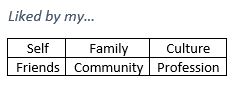
- "My community & I",
- "My culture & I", and/or
- "My profession & I".

This may seem like a benign (even superfluous) augmentation, but it's designed to shift awareness away from organism centricity to the wider range of social subsystem correlations that we'd like to nurture. Moreover, it will provide data on the shifts in focus that a given post elicits in that post's audience.
Thus for example posts that elicit a focus on politics when the topic is some natural process (like a pandemic) that we need to bring technical knowledge to bear on will automatically show up as a professional topic with few professional likes. Likewise when experts (say in astronomy) make assertions about elements of culture with which they have limited experience.Monday, November 23, 2020
O-centricity & COVID
The COVID-19 choices given to us by nature (not people) have always been simple: Wear masks together or shut down your economy if you don't want way more than 2 folks in the US to die every 3 minutes.
Our organism-centric thinking instead imagines the problem is other people, e.g. (i) wanting to tell you what to do, (ii) trying to trick you into paying more taxes, or (iii) out to get your boss, etc. This latter way of thinking is an evolved trait that's had survival value in the past, but does not have survival value in this case.
Wednesday, October 21, 2020
symptom vs. disease
Don't confuse the symptom (like a giant pus-filled pimple) with the disease. The cure for the latter likely involves constructive adaptation to the new speed at which ideas can be replicated across the globe electronically.
Saturday, October 17, 2020
what narrative to chose
This depends on the audience. An audience equipped to work toward a healthy future might be better served with balanced narratives, allowing them to make decisions based on their own interests. Such narratives are likely to focus on demographic information and on incoming data (often statistical) about processes afoot.
If you instead want to decide for (e.g. to simply manipulate) an audience, your narrative should be one-sided and focus on personalities or organism-centric anecdote i.e. on paleolithic triggers like fear, "bad-guys", and xenophobia. In this electronic information age, the gullibility of audiences to these strategies has proven itself again and again, from the invention of radio in the early 20th century through to today's internet of social media.
Tuesday, October 6, 2020
cartoon obsession
Leadership concepts evolved in modest-sized groups and communities, but modern communications extends them to larger communities where leadership becomes a media figment rather than a relationship.
The mismatch is especially apparent in election years, because figment promotion eclipses the statistical process challenges that are hitting our communities where it hurts.
Hence discussion of mindfulness, measurement, and mitigation of the latter might be worth a bit more attention, even if there is a windfall in money for cartoons.
Thursday, August 27, 2020
the anecdote lurch
Data on whole communities is something that can provide a heads up on trends in community health on all levels. Alas, our visceral reactions are more attuned to anecdote than to "data about many".
Electronic media (starting with radio, then TV and now the internet) are therefore able to trigger visceral reaction to anecdote, while the "data about many" (which signals real developments in the bottom line) is ignored. The result is a plethora of unbalanced narratives with strong feelings on all sides, which are often uninformed to the real trends and issues tht we'd all like to manage.
Monday, July 20, 2020
shared adaptations
Thanks to our evolutionary history over the last million years (and then some), we share:
- recognition of our family as different from "non-family", although known as "nepotism" when overdone, as "subsystem correlations that look inward from our genetic code pool" is a key element of our social structure,
- recognition of our culture as different from "other culture", although known as "discriminant racism" when overdone, as "subsystem correlations that look inward from our idea code pool" is also a key element of our social structure.
- obsession with organism-centric anecdotes (especially about folks who are either "super bad" or "super good") as distinct from statistically significant data (Zzz...) on processes that are key to our individual and community health in the world around.
Sunday, June 7, 2020
Balance narratives...
...but be cautious, because the opposite of an unbalanced narrative is automatically also unbalanced.
Wednesday, June 3, 2020
anecdotes & o-centricity
Modern electronic communications give audio-visual anecdotes new power, but their appeal to our paleolithic adaptions (like organism centricity in general and our attraction to leader worship in particular) can also decrease our awareness of quantitative developments in the larger processes that affect community-level health. What are some ways to help out with this problem?
Tuesday, April 14, 2020
Saturday, February 29, 2020
yellow reporting
New roles for technology historically give rise to often unexpected consequences, that stem from the fact that our paleolithic adaptations did not take them into account. The list includes tools for transportation, housing, and fighting. It also includes communication technologies. Invention of the printing press for books and newspapers, of radio, of television, and of the internet are some of the more memorable examples.
Yellow journalism historically is associated with communications that are rewarded by their consumers not for their usefulness but for their sensationalism, or for the fear and/or xenophobia that they trigger, etc. Yellow reporting in that sense is of course now born again in new ways with modern social media, and that rebirth includes not only reporting about policy issues and matters of belief, but also about science. The worst examples of this are linked to the personal injury suit industry, but empty sensationalism in routine scientific reporting is also all over the place. Might in that context a more sophisticated approach to balanced narratives be helpful for the general public, as well as for journalism professionals?
Yellow journalism historically is associated with communications that are rewarded by their consumers not for their usefulness but for their sensationalism, or for the fear and/or xenophobia that they trigger, etc. Yellow reporting in that sense is of course now born again in new ways with modern social media, and that rebirth includes not only reporting about policy issues and matters of belief, but also about science. The worst examples of this are linked to the personal injury suit industry, but empty sensationalism in routine scientific reporting is also all over the place. Might in that context a more sophisticated approach to balanced narratives be helpful for the general public, as well as for journalism professionals?
Monday, December 30, 2019
narrative collapse
Layers of organization in our communities include those that look: (a) outward from the boundary of individual families including matters of social hierarchy i.e. politics, (b) inward from the boundary of culture including sports and religion, and (c) outward from the boundary of culture including the guidelines for many professions. In this context two effects on narrative, that reduce its effectiveness, may be expected to occur especially when resources are scare.
One of these effects is that narrative on levels (b) and (c) may be trivialized to level (a) thinking, i.e. politicized. This for example happens with different groups when the topics of inequality and climate-change come up, with the result that the structural problem and consequences underlying these things end up being ignored.
The second effect, that works hand in glove with the first, is our tendency to think of causes as organismic, i.e. to explain problems in terms of bad guys and good guys, rather than in terms of natural processes in a world which will always be sending us new challenges. As a result, we have a tendency to react to real effects in the world around by focusing on a personality soap opera that has little to do with the problem itself.
How can we fix that?
One of these effects is that narrative on levels (b) and (c) may be trivialized to level (a) thinking, i.e. politicized. This for example happens with different groups when the topics of inequality and climate-change come up, with the result that the structural problem and consequences underlying these things end up being ignored.
The second effect, that works hand in glove with the first, is our tendency to think of causes as organismic, i.e. to explain problems in terms of bad guys and good guys, rather than in terms of natural processes in a world which will always be sending us new challenges. As a result, we have a tendency to react to real effects in the world around by focusing on a personality soap opera that has little to do with the problem itself.
How can we fix that?
Thursday, December 12, 2019
income & offspring
Eric Chaisson has argued that community-level health (e.g. as measured robustly by task layer multiplicity) is linked to free energy per capita. This is expected to peak (and perhaps has peaked in some places) as our environmental impact builds and as our population continues to grow.
Although wealth imbalance clearly hurts community-level health, arguments for blind redistribution are well-known to put incentives (i.e. natural selection pressures) in the wrong place. In steady-state, income should be linked with contributions to community-level health e.g. to the nurturing of subsystem correlations (especially one's own) that look in & out from the boundaries of skin, family and culture.
How to do this in the face of pressure from defectors (this is part of human nature) will always be a work in progress. But it does mean that sustainable-incentive based resource distribution, which limits population growth as well as sequestration of resources in a tiny fraction of the population, is part of our challenge now and in the future.
Although wealth imbalance clearly hurts community-level health, arguments for blind redistribution are well-known to put incentives (i.e. natural selection pressures) in the wrong place. In steady-state, income should be linked with contributions to community-level health e.g. to the nurturing of subsystem correlations (especially one's own) that look in & out from the boundaries of skin, family and culture.
How to do this in the face of pressure from defectors (this is part of human nature) will always be a work in progress. But it does mean that sustainable-incentive based resource distribution, which limits population growth as well as sequestration of resources in a tiny fraction of the population, is part of our challenge now and in the future.
Thursday, July 18, 2019
Opposites
The opposite of an unbalanced narrative is also an unbalanced narrative. We can do better than both.
Subscribe to:
Posts (Atom)