

In the spirit of the phrase used by Marie Kondo, what sparks joy for you? Also, what are some ways that folks might redirect what sparks joy for them to include helping spark the joy of others?
Tuesday, June 14, 2022


Saturday, May 28, 2022
finding what works
If you are serious about any particular problem, ranging from how to fix a dripping faucet or a broken electrical circuit to making gerrymanders constructive, minimizing abortions, or reducing gun deaths, consider adopting a scout (versus soldier) mindset and embark on the cycle: Observe → selectModel → predictOptions → Implement → Observe....
This "V↔S" cycle (vary then select then vary etc.) is not only how (for example) science works (although it often also gets bogged down in doctrine), but also how life on earth has always worked. In other words it's part of perhaps our oldest constitution, namely that on the basis of which life itself continues to adapt and survive.
- In this context how may we get media to focus on problems that folks could agree to collaborate on solving, using model strategies and data-based observations that can track progress and thereby lead to making things better? For instance folks on both local and global scales might agree to work toward: (i) fewer gun deaths, (ii) fewer abortions, (iii) fewer COVID infections, (iv) constructive redistricting, (v) community-oriented policing, (vi) minimizing unconstructive use of tax dollars, (v) a healthier middle class, etc.
Friday, January 8, 2021
Kool-aid danger
It's one thing to drink the kool-aid. You may not be able to help that. It's another thing to start spreading it for profit.
Aside: The "kool-aid" available on social media, which captures hearts and minds in unbalanced narratives of all sorts, is all about the idea that other people are the problem, when in fact the kool-aid itself is one of various natural processes whose "taming" will point the path to better outcomes downstream.
Saturday, December 19, 2020
The hype machine
The book by this title from Sinan Aral suggests that social media might adapt their LIKE BUTTON to a set of six buttons to indicate the responder's impression that the post is liked by:
- "I as an individual",
- "My friends & I",
- "My family & I",
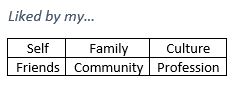
- "My community & I",
- "My culture & I", and/or
- "My profession & I".

This may seem like a benign (even superfluous) augmentation, but it's designed to shift awareness away from organism centricity to the wider range of social subsystem correlations that we'd like to nurture. Moreover, it will provide data on the shifts in focus that a given post elicits in that post's audience.
Thus for example posts that elicit a focus on politics when the topic is some natural process (like a pandemic) that we need to bring technical knowledge to bear on will automatically show up as a professional topic with few professional likes. Likewise when experts (say in astronomy) make assertions about elements of culture with which they have limited experience.Monday, November 23, 2020
O-centricity & COVID
The COVID-19 choices given to us by nature (not people) have always been simple: Wear masks together or shut down your economy if you don't want way more than 2 folks in the US to die every 3 minutes.
Our organism-centric thinking instead imagines the problem is other people, e.g. (i) wanting to tell you what to do, (ii) trying to trick you into paying more taxes, or (iii) out to get your boss, etc. This latter way of thinking is an evolved trait that's had survival value in the past, but does not have survival value in this case.
Wednesday, October 21, 2020
symptom vs. disease
Don't confuse the symptom (like a giant pus-filled pimple) with the disease. The cure for the latter likely involves constructive adaptation to the new speed at which ideas can be replicated across the globe electronically.
Saturday, October 17, 2020
what narrative to chose
This depends on the audience. An audience equipped to work toward a healthy future might be better served with balanced narratives, allowing them to make decisions based on their own interests. Such narratives are likely to focus on demographic information and on incoming data (often statistical) about processes afoot.
If you instead want to decide for (e.g. to simply manipulate) an audience, your narrative should be one-sided and focus on personalities or organism-centric anecdote i.e. on paleolithic triggers like fear, "bad-guys", and xenophobia. In this electronic information age, the gullibility of audiences to these strategies has proven itself again and again, from the invention of radio in the early 20th century through to today's internet of social media.
Subscribe to:
Posts (Atom)